

🔥 Fire & ICE — Maps, Math and Manual Mastery

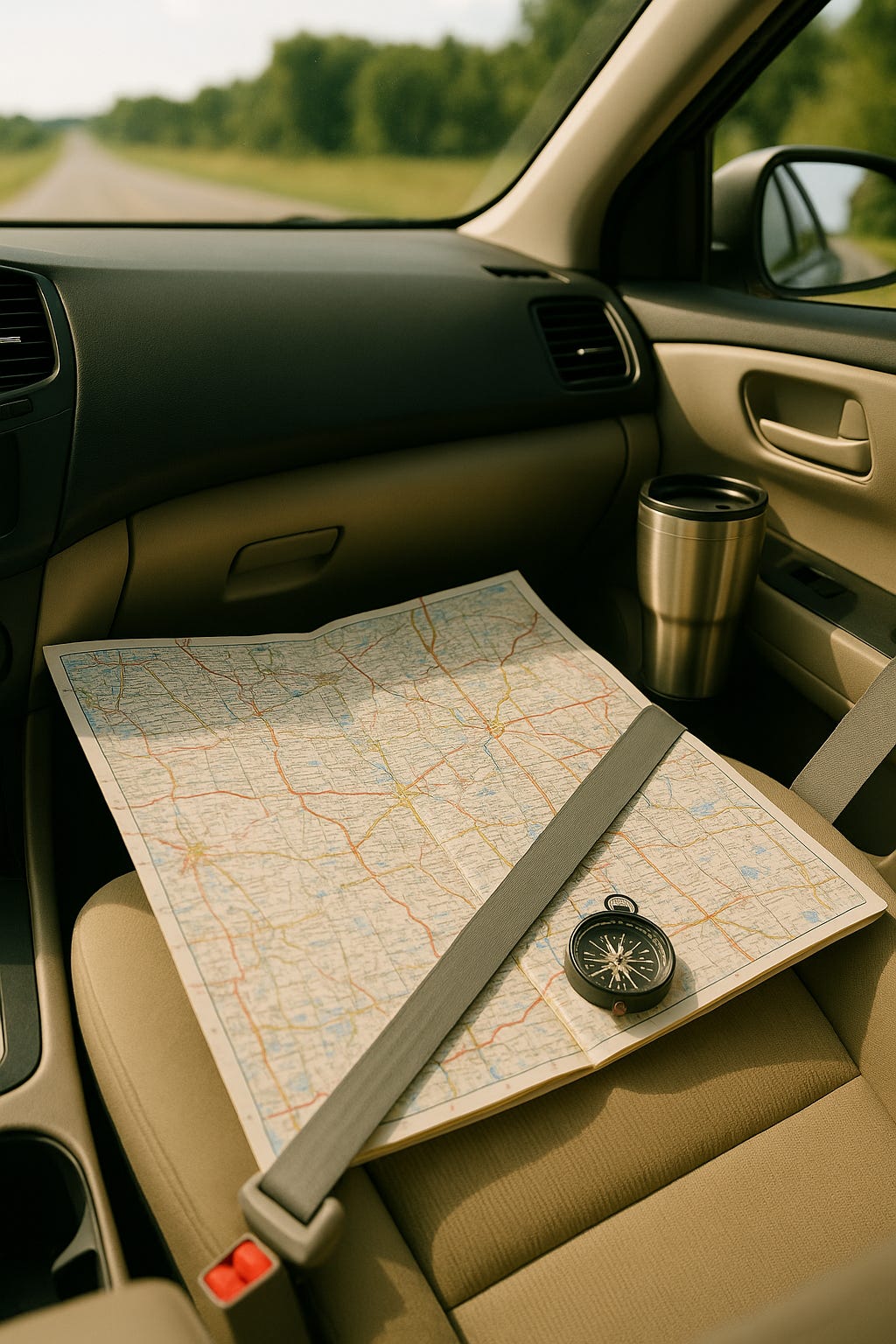
Life Before GPS
Before a phone told you where to turn, the road didn’t simply unfold — you had to earn it.
A trip wasn’t coordinates and convenience. It was a small private expedition you planned inside the car, on the hood of the car, or in the garage the night before. It took skill, patience, a little math, and a willingness to learn what the road was trying to tell you.
There was a time when getting somewhere proved something.
About your confidence.
About your preparation.
About your relationship with ICE.
Because your engine would take you as far as you wanted —
but you had to know where “far” was.
The Glovebox Command Center
Every real driver had a glovebox that looked like a pocket-sized library of American geography:
a road atlas with counties outlined in faded blues and reds
a couple of state-issue fold-outs from gas stations
maybe a laminated local map with coffee-ring circles
a pen that barely wrote
a tire gauge
and a receipt that always marked the last known town you were sure of
These weren’t props. These were tools.
A well-used map wasn’t ornamental — it carried the wrinkles of experience.
A rip near an interstate? That’s where the kids spilled a milkshake.
A note scribbled near an exit? Best diner in the county.
A page permanently creased?
That was a night you were really, truly lost — and had to figure it out.
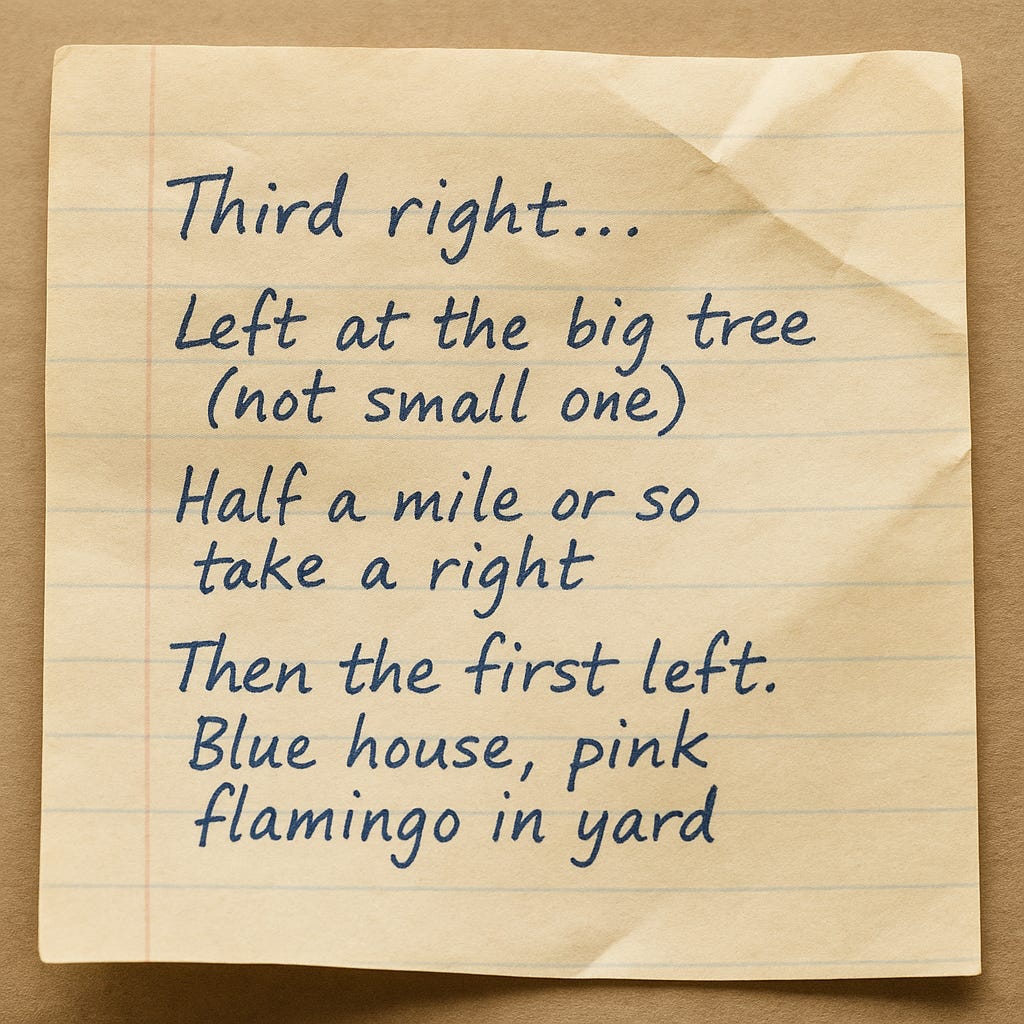
When Navigation Was a Group Project
Before GPS, the passenger seat wasn’t optional.
It was a co-pilot’s chair.
Someone had to unfold a map the size of a bedsheet and whisper,
“Okay… okay… I think we stay on 12 until the river.”
You learned how to:
follow a route
anticipate a turn
watch for mile markers
match landmarks to sketches
and translate a paper grid into real geography
This wasn’t multitasking. It was shared concentration.
Families navigated together. Couples learned each other’s patience.
Kids memorized town names long before they could spell them.
And every one of those moments helped build the same thing:
Situational awareness — the lost art of modern mobility.
Math in Motion
Driving without GPS meant doing quick calculations that actually mattered:
How many miles until empty?
What’s our time if we add ten minutes per stop?
If we average 56 mph, can we make Grandma’s by supper?
Mileage became math.
Math became instinct.
Instinct became responsibility.
And in the end, anticipation became reality.
Fire & ICE taught you to hear your engine, but manual navigation taught you to hear your surroundings — highways, weather, distance, daylight.
This was real-world arithmetic that built real-world adults.
Reading the Land, Not the Screen
Before a phone told you everything, you learned to see:
the shadow of a grain elevator miles before the town sign
the way an S-curve shaped itself in the treeline
how a ridge signaled a coming valley
how small towns always hid behind railroad tracks
and how the highway changed color right before a state line
A road wasn’t just a path.
It was a story — and you were learning to read it.
Mapping was literacy.
Orientation was craftsmanship.
Getting lost was apprenticeship.
You weren’t following instructions.
You were participating in the world.
Humble Mastery — The Pre-GPS Superpower
There’s a quiet dignity in knowing where you are without asking a satellite.
It’s not about nostalgia.
It’s about skill.
Manual navigation required:
attention
discipline
adaptability
teamwork
patience
and respect for the road
Every time you opened a map, you weren’t just planning a trip.
You were sharpening your ability to:
think ahead
estimate risk
solve problems with incomplete information
trust your judgment
and lead others with confidence
These are analog traits — stronger than any signal and immune to dead batteries.
Where the Road Meets the Land
GPS didn’t make us worse drivers.
It just made us quieter ones — more reliant than aware.
Fire & ICE yearns for something richer:
Not to abandon convenience…
but to remember the craftsmanship behind the journey.
The irony is this:
The more GPS and EVs take over the cockpit,
the less we’re in touch with the land beneath the wheels.
In our quest to “go green,”
we’ve forgotten how connected to the earth
our ICE hearts once were —
and still can be.
Because a driver guided by satellites knows where to turn…
but a driver guided by ICE and maps knows where they are.
One knows directions.
The other knows the land.
One follows.
The other participates.
Both will reach the destination —
but only one truly travels.
Manual mastery isn’t outdated — it’s foundational.
Because the road doesn’t just ask you to go.
It asks you to understand.
Jason Spiess is an multi-award-winning journalist, entrepreneur, producer and content consultant. Spiess, who began working in the media at age 10, has over 35 years of media experience in broadcasting, journalism, reporting and principal ownership in media companies. Spiess is currently the host of several newsmagazine programs that air across a 22 radio stations and podcasts worldwide through podcast platforms, as well as a combined Substack and social media audience of over 500K followers. Connect with Spiess on LinkedIn or Follow his personal professional site Spiess On Earth
All Energy Has A Purpose and We Are All Energy!
The Crude Life republishes their articles, features and stories online and/or in print under Creative Commons license CC BY-NC-ND 4.0.
Everyday your story is being told by someone. Who is telling your story? Who are you telling your story to?
Email your sustainable story ideas, professional press releases or podcast submissions to thecontentcreationstudios(AT)gmail(DOT)com.
CLICK HERE FOR SPECIAL PARAMOUNT + DISCOUNT LINK
Landman Release Date, Format & Where to Watch
Premieres: Sunday, November 16, 2025
Streaming platform: Paramount+ (exclusive)
Episode format: Weekly releases—no binge drop, one episode every Sunday
Season 1: Still available to stream for catch-up
The part about navigaton being a shared experience realy resonates. GPS turned every passenger into a passive observer instead of a co-pilot. There's something valueable about needing to work together to find your way. That kind of teamwork and communication built relationships in ways that auto-routing never could. Plus the mental discipline of keeping track of landmarks and estimating distances was a skill that transferred to other areas of life.
It makes me wish somehow for those years to come back. I admit with GPS I have become lazy and sometimes am not even sure where I am. I am a long haul trucker and have to admit that the location portion in my brain probably sometimes turns off, because I am focused just on the traffic and the safety factor. As I sit here and think about it, I am saved by the GPS giving me that notice that soon I have to make a turn.
Are our minds getting used to working at 50%?